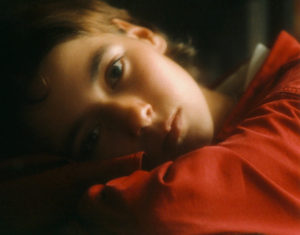

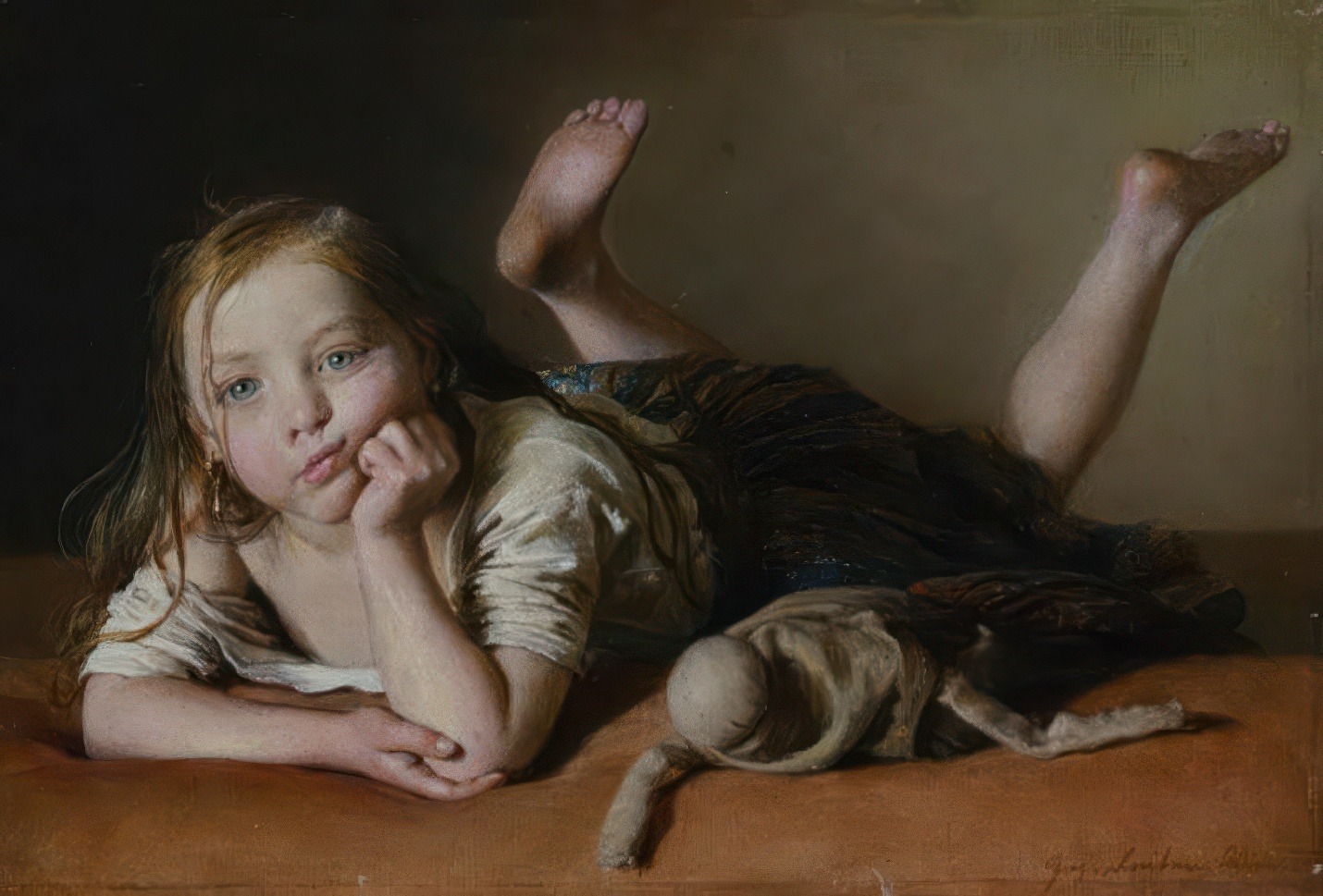
My third choice in Love Songs of Childhood tells with beautiful words the ordinary life of the old doll cherished by a little girl.
LADY BUTTON-EYES
WHEN the busy day is done,
And my weary little one
Rocketh gently to and fro;
When the night winds softly blow,
And the crickets in the glen
Chirp and chirp and chirp again;
When upon the haunted green
Fairies dance around their queen—
Then from yonder misty skies
Cometh Lady Button-Eyes.
Through the murk and mist and gloam
To our quiet, cozy home,
Where to singing, sweet and low,
Rocks a cradle to and fro;
Where the clock’s dull monotone
Telleth of the day that’s done;
Where the moonbeams hover o’er
Playthings sleeping on the floor—
Where my weary wee one lies
Cometh Lady Button-Eyes.
Cometh like a fleeting ghost
From some distant eerie coast;
Never footfall can you hear
As that spirit fareth near—
Never whisper, never word
From that shadow-queen is heard.
In ethereal raiment dight,
From the realm of fay and sprite
In the depth of yonder skies
Cometh Lady Button-Eyes.
Layeth she her hands upon
My dear weary little one,
And those white hands overspread
Like a veil the curly head,
Seem to fondle and caress
Every little silken tress;
Then she smooths the eyelids down
Over those two eyes of brown—
In such soothing, tender wise
Cometh Lady Button-Eyes.
Dearest, feel upon your brow
That caressing magic now;
For the crickets in the glen
Chirp and chirp and chirp again,
While upon the haunted green
Fairies dance around their queen,
And the moonbeams hover o’er
Playthings sleeping on the floor—
Hush, my sweet! from yonder skies
Cometh Lady Button-Eyes!
Source of the poem: Love-Songs of Childhood by Eugene Field. New York: Charles Scribner’s Sons (1926). Digitised on Internet Archive and as a Project Gutenberg Ebook. The poem is on page 61.
Other source: Poems of Childhood by Eugene Field, with illustrations by Maxfield Parrish. New York: Charles Scribner’s Sons (1904). Digitised as a Project Gutenberg Ebook and hypertext version on Wikisource. The poem is on page 161.
Good Morning,
Very interesting site for beautiful paintings.
Thanks for sharing.
Have a good day always.
Regards and blessings
Uma